Data literacy is becoming increasingly important because students deal with enormous amounts of data and information every day. It is not just about being able to read numbers, but primarily about understanding, critically evaluating, interpreting, and responsibly using data.
Important arguments for prioritizing data literacy in education:
Better information evaluation
Students must be able to assess whether numbers, graphs, and statistics are reliable or presented in a misleading way.
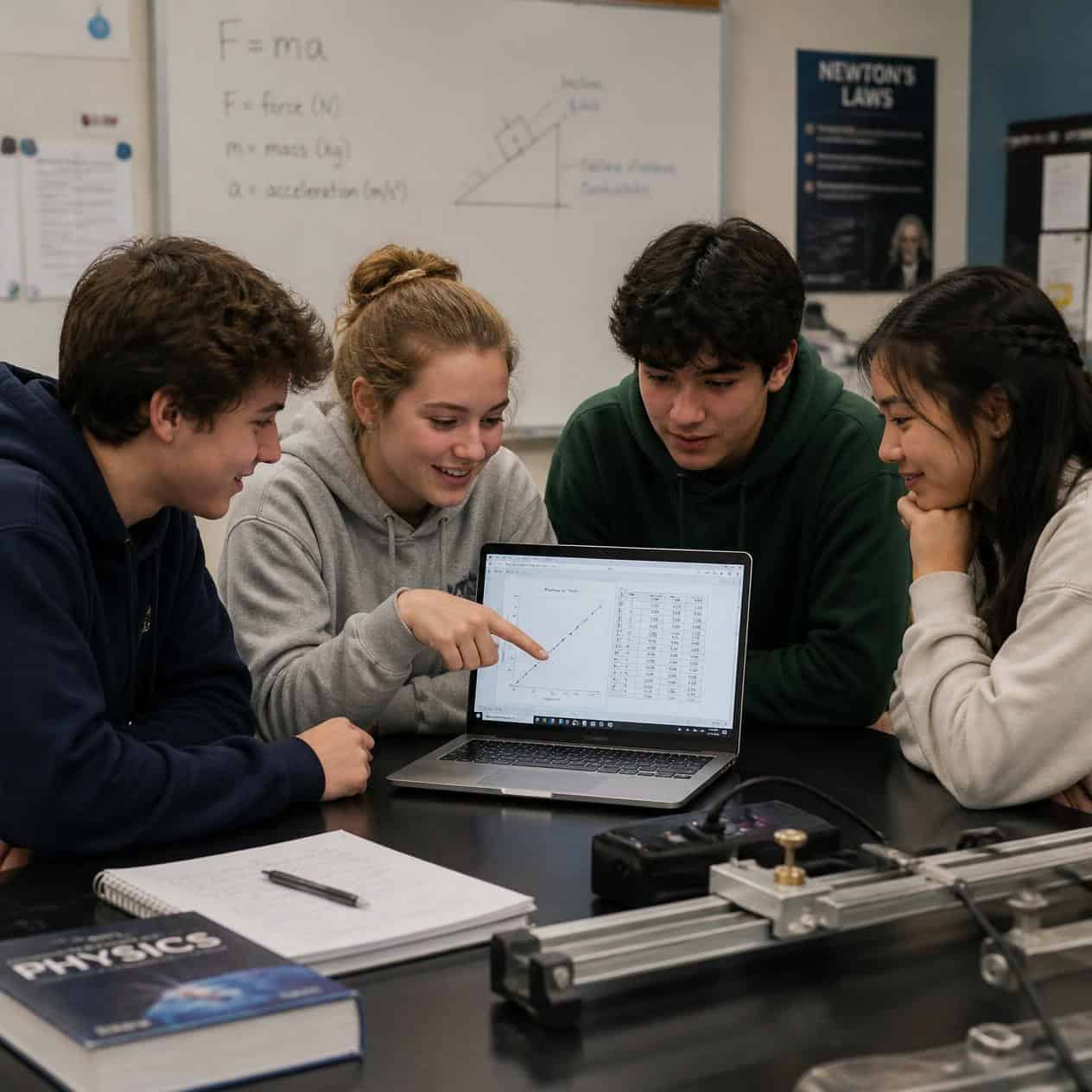
With the Coach program, students work with data tables and graphs and can consult statistical data themselves. Moreover, they simultaneously learn about physics, chemistry, biology, or mathematics, as well as how to work with software and hardware. That is why the Coach software is indispensable for every school that wants to make this a priority, and is an all-round STEM solution.
Critically Dealing with Media
News, social media, and algorithms constantly use data. Data literacy helps students not to simply accept claims as truth. Numbers are also often presented as the truth in public debate. Students must learn to critically evaluate this information.
Preparation for further education and work
Data is used in virtually all fields and professions. This data is almost always presented in tables and graphs. In Coach, students learn how to handle data and computer models.
- Computer Science – working with databases, algorithms, and datasets.
- Business Administration – using data for marketing, sales, customer analysis, and business decisions.
- Economics – analyzing economic figures and statistics.
- Sociology – examining large datasets regarding, for example, behavior, work, and societal developments.
- Medicine – using patient data, research results, and medical statistics.
- Biology – analyzing, for example, DNA, population, and ecological data.
- Marketing & Communication – analyzing customer behavior, social media data, and campaign results.
- Exact sciences such as mathematics, physics, and chemistry cannot function without data and computer models.
Therefore, data literacy is actually relevant for many more study programs than just technical studies.
Insight into AI and algorithms
AI systems and algorithms work with data. If students understand how data is collected and interpreted, they can better understand AI and use it more critically.
Awareness of privacy (on social media and elsewhere)
Students learn what data is collected about them and what consequences that can have.
In short: data literacy is a collection of important basic skills to be able to function independently, critically, and responsibly in a society where data is ubiquitous.
Digital information skills are trained very strongly with the Coach software. Understanding data in tables and graphs, and relating these to phenomena in the physical world, is one of Coach’s strengths. You can also learn to understand (simple) models with Coach.
Would you like to know more about this? Then please contact CMA Science. Or take a look at our teaching materials.
Computational thinking is a basic skill that can be easily taught using free software like Scratch, or with robotics lessons such as those from VEX Robotics.
Coach also includes a programming language that allows you to control actuators. This enables students to set up a Smart Home or program a greenhouse. With the CMA Science system board, students truly learn the basics of how (computer) systems work.
Want to know what else you can do with the Coach 7 software? Get the full overview here.